
Emergency Air Duct Cleaning Near Me: What Stockton Homeowners Should Do First
If you’ve found a dead animal in your ductwork and your first call was to a duct cleaner, you likely skipped the step that decides whether your duct liner can be saved or has to be replaced. A real duct emergency is contamination moving through your home, not dust you’ve finally gotten tired of. The right first move depends on what got in, and it usually isn’t “book a cleaning.” Shut down or isolate the system, contain the affected registers, document everything for your insurer, then call someone equipped for remediation. If you’d rather not sort that out alone, call (855) 263-2873.
Key Takeaways
- Only three situations count as true duct emergencies: sewage backing into a return, animal decomposition in the supply lines, and smoke or fire residue pulled through the system.
- Before anyone arrives, shut off or isolate the HVAC, seal the affected registers, and photograph everything.
- Standard duct cleaning equipment won’t contain biological contamination. You need HEPA negative-air containment.
- Ask two questions before you book: what containment equipment they carry, and whether they can handle duct repair after the cleanup.
What Actually Counts as a Duct Emergency in Stockton?
Three situations are genuine duct emergencies in a Stockton home: sewage that has backed into a return, a dead animal decomposing inside the supply lines, and smoke or fire residue drawn into the system. Everything else, including heavy dust, musty odors, and reduced airflow, is urgent but not an emergency. The distinction matters because it changes who you should call first. A sewage backup is a plumbing and remediation event before it’s a duct cleaning event. A dead animal in the ducts may mean wildlife removal before any cleaning begins. And smoke infiltration is an insurance claim you’ll want documented before anyone touches the system.
The reason the distinction saves money is sequence. If a contractor cleans ducts before the source of contamination is removed, they spread it. A dead rodent that gets dislodged and pulled deeper into the supply run leaves residue behind a liner you’ll then pay to replace. Sewage pulled through a return with a shop vac contaminates the whole path. These are the calls where the wrong order of operations costs more than the cleaning itself. In Stockton’s older housing stock, where duct runs in some neighborhoods sit under a raised foundation and liner already shows its age, that mistake is expensive to undo.
What Should You Do Before the Technician Arrives?
The first thing to do is shut off the HVAC or isolate the affected zone, seal the nearest registers, and photograph everything before anyone cleans. Do not run the fan to “clear the smell.” Running the system is exactly what pushes contamination through the rest of the house. In our experience, the calls that go smoothly are the ones where the homeowner did three things before we arrived: stopped the airflow, contained the area, and documented the scene.
Here’s a practical sequence for a Stockton home while you wait:
- Stop the system. Turn off the thermostat at the wall, not just to “fan only.” If the contamination is in one zone, close the supply registers feeding that zone and cover them with plastic sheeting and painter’s tape.
- Seal the affected registers, not every register. Sealing the whole house traps odors and creates pressure. Seal the ones closest to the contamination source, then leave the rest alone.
- Photograph the source and the registers. Photos of the affected return grille, the register faceplate, and any visible staining are the evidence your insurer wants.
- Write down the shut-off time. Note the exact date and time you turned off the HVAC. That timestamp establishes how long the system was idle, which matters for moisture and mold questions.
- Keep an odor log. Note when the smell is strongest, which rooms it appears in, and whether it changes with weather or time of day. A short log beats a vague memory.
Concrete-floor slab homes in Stockton often run ductwork overhead in the attic, so heat and summer temperature swings can accelerate odor migration. That’s another reason to stop airflow early rather than wait.
When Should You Call a Pro vs. Wait?
Call a professional immediately when the contamination source is sewage, animal decomposition, fire residue, or visible mold inside a duct. Waiting on these lets contamination spread and complicates insurance. Ordinary dust buildup, musty smells you can’t trace, and reduced airflow can usually wait for a scheduled visit. The dividing line is whether something biological or hazardous is in the system.
Most of what we clean in Stockton is not an emergency. It’s a well-worn system that’s simply overdue. The calls that do qualify as emergencies need a different response from a standard residential cleaning. If you’re in the urgent-but-not-emergency category, a normal scheduled visit will handle it. Our technicians have up to experience and can tell you on the phone which category you’re in.
For the routine version of this work, you can read more about air duct cleaning and what a standard whole-system visit involves. If the problem is odor and poor airflow from a dryer, our dryer vent cleaning page covers that separate fire risk. And for the broader picture of what we do, the main Duct Cleaning Stockton page covers all three services.
Why Do Contamination Events Need Different Equipment Than Standard Cleaning?
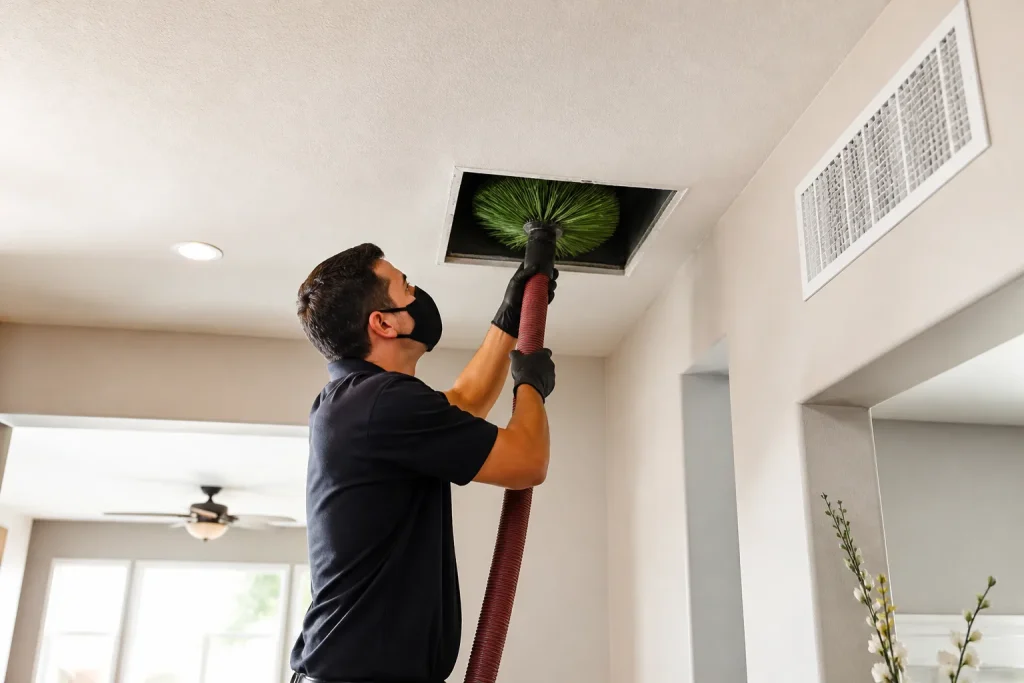
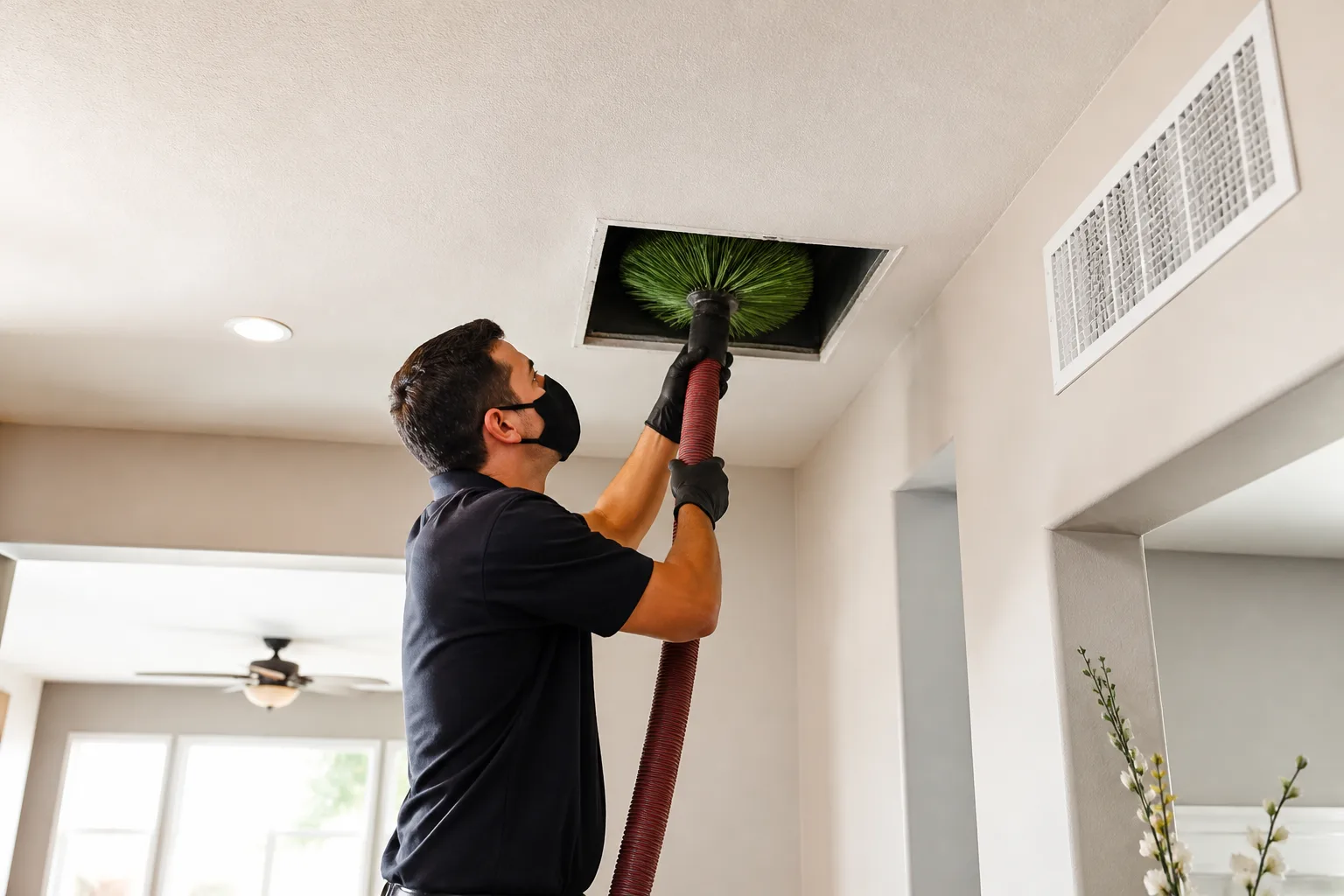
Contamination events need HEPA filtration and negative-air containment. Standard duct cleaning runs a rotary brush through the system with vacuum extraction attached. That’s the right tool for dust, debris, and light buildup. It does not contain airborne pathogens, sewage aerosols, or decomposition residue. For those, the work needs the same containment approach used in remediation. We use Abatement Technologies negative-air and HEPA equipment for that purpose, and our standard cleaning runs on Rotobrush rotary brush systems.
Containment changes the job in concrete ways:
- Negative air pressure keeps dislodged particles from drifting into living space. Air is pulled through a HEPA filter instead of leaking into the room.
- HEPA-rated vacuum capture at the source traps fine particulate rather than blowing it around.
- Surface protection underneath the work area, using Guardsman products, keeps the rest of the home clean during a heavy job.
- Post-cleaning inspection confirms the contamination pathway is actually clean, not just visually dusty.
In a Stockton ranch home with a single central return, negative-air containment is what keeps contamination from travelling through the entire system during the job. This is where a shop vac and a box fan approach fails.
How Do You Document a Duct Contamination Event for Insurance?
Document a duct contamination event before any cleaning begins: photograph the source, note the exact shut-off time, keep an odor log, and save every contractor estimate and invoice. Insurers want a clear before-and-after record. If someone starts cleaning first, the evidence of the contaminated source may be gone before the claim is filed.
Here’s what our team would photograph and record for your own file:
- The visible contamination source (return grille staining, the animal itself if present, water lines from a sewage backup).
- Wide shots of the affected room and the register faceplate, with a frame that shows the room so the location is clear.
- The thermostat display when you shut it down, showing the time and set point.
- Any affected personal property: carpet edge staining, furniture near a register, and stored items.
- A dated odor log in one place. A notes app or paper sheet works. Keep it consistent.
Take the photos in daylight, not under a phone flash. In Stockton’s older homes, where return grilles may be painted shut or mounted flush, a straight-on shot shows stains better than an angled one. Save the whole record as one dated folder before you call anyone.
How Do You Know a Cleaning Company Is Equipment-Ready for Real Remediation?
Ask any “emergency duct cleaning” company two questions before you book: what containment equipment they carry, and whether they handle duct repair after cleanup. A standard residential van repurposed for emergency calls will usually answer with vague reassurances. A properly equipped crew can name their HEPA setup and their repair scope without thinking about it.
These are the questions we’d want a homeowner in Stockton to ask us, or anyone else:
- “What HEPA equipment do you carry?” A real answer names the containment system, not “we use special filters.” We run Abatement Technologies negative-air and HEPA units, and Rotobrush and Nikro systems for standard cleaning.
- “Do you do duct repair, or just cleaning?” Contamination events often damage liner or connections. A crew that only cleans will leave you booking a second company. We repair what we find, not just clean around it.
- “Do you carry surface protection?” For a heavy job in an occupied home, Guardsman products on-site tell you whether the crew respects the interior.
- “How will I see what you removed?” Before-and-after photos of your own ducts, not stock photos.
- “Is the price one flat number per system, agreed in writing before work starts?” No per-vent pricing, no coupon bait. The written estimate sets the final price.
Those five answers will separate a genuine remediation-capable crew from one that will call a shop vac “commercial equipment.”
The Bottom Line
Real duct emergencies come down to three situations: sewage, animal decomposition, and fire or smoke residue. Everything else is urgent but not emergency. If you’re in that first group, stop the airflow, seal the affected registers, photograph everything, and call someone equipped with HEPA containment rather than a repurposed residential unit. If you’re in the second group, you have time to plan.
We’re Duct Cleaning Stockton, and we work with three linked systems: air duct cleaning, dryer vent cleaning, and duct repair. We use purpose-built equipment, not improvised tools, and we give one flat price per system agreed in writing before work starts. Our technicians have up to experience. If you’re in the Stockton area and you’re not sure whether your situation is an emergency or an overdue cleaning, call (855) 263-2873 for a free estimate. We answer 24/7. Fast dispatch from 7am to 7pm, Sunday through Friday.
Frequently Asked Questions
Pricing depends on the scope and whether containment is needed, and it’s set per job by the written estimate. There’s no per-vent charge and no coupon teaser. The written estimate gives you one flat price for the whole system. Call (855) 263-2873 for an exact quote. Estimates are free.
Because they’re usually built around a low coupon that grows once the technician is on site, or they skip containment equipment entirely. A low quote that omits HEPA filtration on a sewage or animal job isn’t saving you money; it’s shifting the cost to cleanup later. We quote one flat price per system and agree it before work starts. Call (855) 263-2873. We answer 24/7.
Ask for before-and-after photos of your own ducts, taken during the job, not stock images. The crew should be willing to show you what was removed and where. Every job we do includes before-and-after photos. Call (855) 263-2873 for a free estimate.
Most homes don’t need it on a fixed schedule. Clean when dust buildup is visible, after a renovation, when musty odors or reduced airflow appear, or after a contamination event like the three emergencies covered above. Routine cleaning is a reaction to conditions, not a calendar item. Call (855) 263-2873 and we’ll tell you honestly whether you need it.
Written by the team at Duct Cleaning Stockton.
Need Air Duct Cleaning Help?
Call Duct Cleaning Stockton - licensed & insured, with free written estimates in Stockton.
(855) 263-2873